
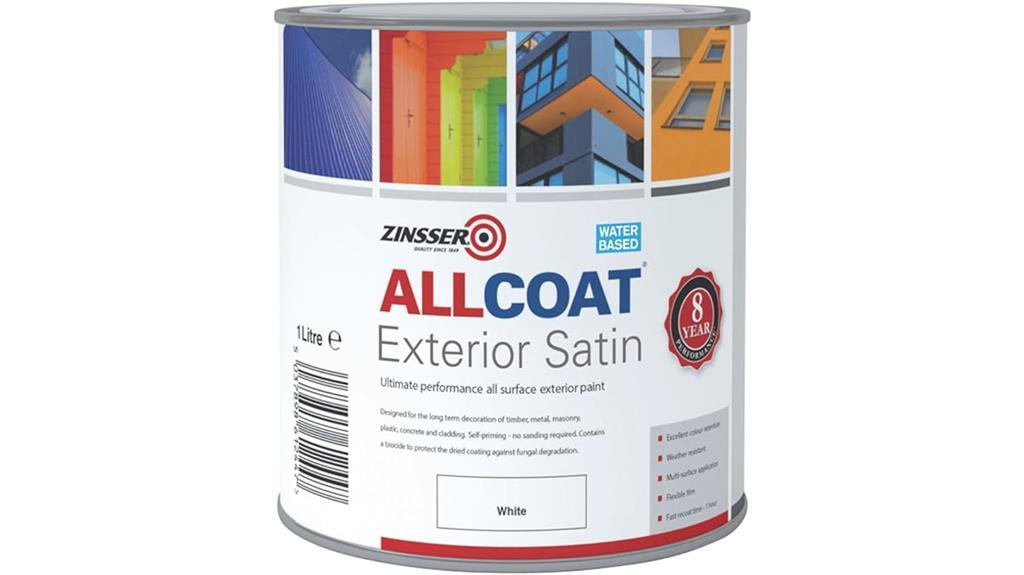
Professional verdict: Zinsser AllCoat Exterior Satin is a capable, versatile coating, but buying the correct tin is only a small part of producing a durable kitchen-cupboard finish. Surface identification, contamination removal, compatibility testing, repairs, controlled application, drying conditions and careful reassembly all affect the result.
David has approximately 40 years of painting and decorating experience. His opinion in this review is based on practical use and on assessing and repainting different types of kitchen cupboards. It should not be mistaken for a promise that this paint will perform equally well on every kitchen surface.
Affiliate disclosure: As an Amazon Associate I earn from qualifying purchases. If you buy through an Amazon link on this page, I may receive a small commission at no extra cost to you.
- What Is Zinsser AllCoat Exterior Satin?
- Why the Paint Tin Is Not the Complete System
- The “No Sanding” and “Self-Priming” Claims Need Context
- Why Kitchen Preparation Is More Involved Than It Appears
- Application: Brush and Mini Roller Rather Than a Shortcut
- Matt Finish and the Challenge of Roller Tramlines
- Recoat Time Is Not the Same as Full Cure
- Colours and the Importance of the Correct Tint Base
- Advantages and Limitations
- Is It a Sensible Purchase for DIY Use?
- David's Professional Verdict
- Frequently Asked Questions
- Conclusion
- What Is Zinsser AllCoat Exterior Satin?
- Why the Paint Tin Is Not the Complete System
- The “No Sanding” and “Self-Priming” Claims Need Context
- Why Kitchen Preparation Is More Involved Than It Appears
- Application: Brush and Mini Roller Rather Than a Shortcut
- Matt Finish and the Challenge of Roller Tramlines
- Recoat Time Is Not the Same as Full Cure
- Colours and the Importance of the Correct Tint Base
- Advantages and Limitations
- Is It a Sensible Purchase for DIY Use?
- David's Professional Verdict
- Frequently Asked Questions
- Conclusion
What Is Zinsser AllCoat Exterior Satin?
Zinsser AllCoat Exterior Satin is a water-based, multi-surface coating principally marketed for exterior use. Zinsser lists wood, metal, masonry, plastic, concrete and cladding among its intended surfaces. The product can be applied by brush, roller, pad or airless sprayer.
The current UK product information gives a nominal coverage of 12m² per litre, a touch-dry and recoat time of one hour, and a full cure time of seven days. It is available in selected ready-mixed colours and through tint bases for BS, RAL and NCS colours.
The often-quoted “up to 15 years” claim relates to the product's specified exterior performance. It should not be presented as a 15-year guarantee on kitchen cupboards, where abrasion, grease, cleaning products, knocks and repeated handling create very different demands.
Zinsser describes AllCoat Exterior as an exterior product. Its UK website says leftover product may be used indoors, although it recommends other products for general interior decorating. Kitchen Cupboard Painters' use and assessment of the paint as part of a cupboard-finishing system is therefore David's professional judgement rather than a claim that the manufacturer markets it specifically as kitchen-cupboard paint.
Why the Paint Tin Is Not the Complete System
A common mistake is to assume that choosing a well-known multi-surface paint removes the difficult part of repainting a kitchen. In practice, two cupboards that look similar can require different preparation and supporting products.
- Solid timber can contain knots, open grain, old waxes or historic coatings.
- Factory-painted MDF may have sound faces but vulnerable or moisture-damaged edges.
- Laminate and wrapped doors depend upon the stability of the surface and adhesive beneath it.
- Previously painted cupboards may conceal weak coatings that fail when a stronger new film is applied over them.
- Silicone polishes, cooking oils and cleaning residues can remain on a surface even when it appears clean.
Before a coating system is selected, the construction, condition and previous finish need to be assessed. If the underlying surface is unstable, the performance of the paint on top becomes largely irrelevant.
The “No Sanding” and “Self-Priming” Claims Need Context
Zinsser states that AllCoat Exterior is self-priming for many exterior applications and can adhere to certain previously painted glossy surfaces without sanding. That is useful manufacturer information, but David does not treat it as permission to skip assessment and preparation on kitchen cupboards.
A cupboard door is handled repeatedly at close range and viewed under interior lighting. Small nibs, grease contamination, scratches, poorly feathered damage and weak existing coatings are far more noticeable than they might be on exterior cladding. Mechanical preparation may also be needed to improve the surface profile, remove defects and create a consistent base for a fine hand-finished result.
Some surfaces need a separate specialist primer or sealer despite the self-priming description. Staining, knots, exposed MDF, repairs, uncertain factory finishes and localised damage cannot all be treated identically. Compatibility and adhesion tests may be required before committing to the complete kitchen.
Why Kitchen Preparation Is More Involved Than It Appears
Preparation is not simply a quick wipe followed by paint. Kitchen surfaces collect airborne grease, fingerprints, detergent residues and contamination around handles, ovens, sinks and frequently used doors. These residues can interfere with wetting, adhesion and levelling.
Doors and drawer fronts must also be removed, identified and stored without mixing their positions. Hinges, buffers and fittings need to be managed carefully, while damaged edges, loose joints and old handle holes may need separate decisions before any finishing begins.
The fixed frames, end panels and plinths present a different challenge because they remain in the property. They must visually match the removable pieces finished in the workshop, even though they are being coated in a different environment and orientation.
This is one reason approximately 90% of Kitchen Cupboard Painters' work is completed away from the customer's home. David removes and transports the cupboard doors and drawer fronts himself, while the non-removable sections are prepared and hand-painted at the property.
Application: Brush and Mini Roller Rather Than a Shortcut
Zinsser lists brush, roller, pad and airless spray as suitable application methods for AllCoat Exterior Satin. That does not mean each method automatically produces the same result on detailed kitchen doors.
Kitchen Cupboard Painters uses small rollers and brushes to build a controlled, hand-finished appearance. The amount of paint carried, the sequence used around mouldings and panels, the maintenance of a wet edge and the way adjoining areas are joined all affect the finished surface.
Fast-drying water-based paint can become less forgiving if it is repeatedly worked as it begins to set. Applying too heavily can create sags, ridges or slow curing; spreading it too thinly can reduce coverage and leave an uneven appearance. Temperature, airflow and humidity also influence how the coating behaves.
A professional finish therefore depends upon judgement developed through experience, not simply upon choosing between a brush and a roller.
Matt Finish and the Challenge of Roller Tramlines
AllCoat Exterior is also available in a matt finish, which has become a popular choice for painted kitchens. Zinsser lists the water-based matt product as having a Class 1 wet-scrub rating under ISO 11998. In David's practical experience, a properly cured matt finish remains highly wipeable and can be a realistic alternative to satin for customers who prefer a flatter appearance.
A matt sheen does not remove the difficulty of coating large, flat cupboard doors. These broad surfaces expose differences in film thickness and drying. If adjoining roller passes begin to set before they are joined correctly, the result can be visible bands or raised edges commonly described by decorators as roller tramlines.
This is one of the hardest challenges for a painter who is new to kitchen work. Uneven roller loading, excessive pressure, returning to paint that has started to dry, or losing the wet edge can all leave tell-tale lines across the door. Even David has found that unfamiliar paints, rollers or working conditions require testing because a technique that succeeds with one combination may not behave identically with another.
As part of his developed system, David uses carefully selected, compatible water-based additives where appropriate. These help with adhesion and working properties and can reduce visible brush marks, roller edges and tramlines in most cases. They do not replace preparation or application skill, and the exact combination depends upon the coating, substrate and conditions.
This should not be interpreted as advice to mix an arbitrary additive into AllCoat. An unsuitable product or incorrect amount can affect flow, sheen, drying, curing or durability. Compatibility and proportion form part of David's professional process.
Recoat Time Is Not the Same as Full Cure
The published one-hour recoat time is useful, but it should not be confused with full hardness. Zinsser currently states that the water-based satin product reaches full cure after seven days under the stated conditions.
Actual workshop decisions still depend upon film thickness, temperature, humidity, colour, substrate and the condition of the previous coat. A surface may feel dry while remaining vulnerable to marking, blocking or damage during stacking and refitting.
Kitchen Cupboard Painters' complete finishing system normally involves between five and eight coats of durable water-based products, depending upon the kitchen and the colour change. This does not mean five to eight identical coats of AllCoat. Priming, sealing, intermediate work and finishing requirements vary with the substrate.
A typical project takes approximately 10 to 15 working days. That timescale allows for assessment, removal, preparation, staged coating, drying, inspection and careful refitting rather than treating the manufacturer's minimum recoat time as a production target.
Colours and the Importance of the Correct Tint Base
The water-based satin range can be tinted through the appropriate base to BS, RAL and NCS colours. The correct base matters because pale, deep and transparent-base colours do not cover or behave identically.
Strong colour changes may require additional stages to achieve a consistent finish, particularly around profiles, panel edges and areas that catch the light. Colour selection should also be considered alongside the worktops, flooring, walls and the amount of natural light in the kitchen.
Existing handles are normally best retained. Replacements are possible when the fixing holes match, but changing from one hole spacing to another can require filling and redrilling. Depending upon the door construction and handle position, this does not always produce the neatest result and can turn a straightforward colour change into a more complicated project.
Advantages and Limitations
| Advantages | Limitations and cautions |
|---|---|
| Water-based satin finish | Marketed principally as an exterior coating rather than dedicated kitchen-cupboard paint |
| Multi-surface formulation | “Multi-surface” does not mean every kitchen surface is automatically suitable |
| Brush and roller application permitted | Fast drying can expose poor technique, overworking and uneven joins |
| Tintable to BS, RAL and NCS colours | Different tint bases and strong colour changes can affect coverage |
| Published one-hour recoat time | Full cure is stated as seven days, and workshop conditions still matter |
| Self-priming for many stated uses | Some kitchen substrates, repairs and stains still require specialist preparation or primers |
| Good practical versatility in experienced hands | The paint alone cannot compensate for grease, moisture damage or an unstable existing finish |
Is It a Sensible Purchase for DIY Use?
Zinsser AllCoat Exterior Satin can be a useful purchase for suitable multi-surface and exterior projects when the current technical and safety instructions are followed. Experienced decorators may also value its versatility and tinting options.
It should not, however, be regarded as a one-tin shortcut to a professionally repainted kitchen. A confident DIY user still needs to identify the substrate, establish that the existing finish is stable, resolve damage and contamination, choose compatible preparation products, control the application and allow adequate curing before reassembly and use.
If mistakes occur, correcting a failed coating can take substantially longer than completing the original work. Peeling, chipping, heavy roller texture, sticking doors and visible repairs generally require the affected finish to be taken back to a sound surface before it can be rebuilt.
David's Professional Verdict
Zinsser AllCoat Exterior Satin is a capable product with useful adhesion, application and colour options. David's experience is that it can contribute to an excellent finish on suitable kitchen cupboards when it is selected and used as part of a carefully controlled professional system.
The important phrase is part of a system. The final result depends upon what is underneath the paint, how the kitchen has been used, how the surfaces are prepared, which supporting products are required, how each coat is applied and whether adequate drying and curing are allowed.
For that reason, David would not tell a homeowner that purchasing this paint alone will reproduce the Kitchen Cupboard Painters finish. The product is good; the assessment, preparation and accumulated technique are what turn it into a dependable result.
Frequently Asked Questions
Is Zinsser AllCoat Exterior Satin specifically a kitchen-cupboard paint?
No. Zinsser markets it principally as an exterior multi-surface coating. Kitchen Cupboard Painters' use of the water-based satin product on suitable cupboard components is based on David's own professional experience, assessment and finishing system.
Does self-priming mean kitchen doors need no preparation?
No. Self-priming is not the same as self-preparing. Grease, silicone residue, loose coatings, surface damage, moisture-swollen MDF and unstable laminate all require assessment. Some surfaces or repairs may need separate primers or sealers.
Can it really be recoated after one hour?
The current UK product information gives a one-hour recoat time and a seven-day full cure time. Real working conditions and film thickness still need to be considered, so David does not treat one hour as an automatic schedule for every kitchen component.
Does the exterior 15-year claim apply to kitchen cupboards?
No such conclusion should be drawn. The “up to 15 years” statement is an exterior-performance claim under the manufacturer's conditions. It is not a specific guarantee for cupboard doors exposed to repeated handling, impacts, grease and household cleaning.
Will two coats be enough for a kitchen?
The manufacturer's exterior guidance and a professional kitchen-finishing system are not the same specification. Kitchen Cupboard Painters normally uses a complete system involving five to eight coats of appropriate water-based products, with the exact build determined by the surface, condition and colour change.
Is the matt finish wipeable?
Zinsser currently lists AllCoat Exterior Matt as having a Class 1 wet-scrub rating under ISO 11998. David has found the properly cured matt finish highly wipeable in practice, although any painted surface should be cleaned carefully with suitable non-abrasive products.
Do water-based additives prevent roller marks?
Compatible additives can improve working properties and help reduce brush marks and roller tramlines, but they cannot compensate for poor preparation or technique. David selects and uses them as part of his own system after considering the paint, surface and working conditions.
Can the handles be changed at the same time?
Sometimes, but retaining the existing handles is usually simpler and neater. Replacement knobs with the same single fixing or handles with exactly matching hole centres are the easiest options. Different hole positions require filling and redrilling, which may not always leave the neatest finish.
Conclusion
Zinsser AllCoat Exterior Satin is a versatile water-based product, but its performance on a kitchen cannot be judged from the label alone. A successful cupboard finish depends upon the stability of the existing surfaces and a carefully matched sequence of preparation, supporting products, application and curing.
If you are purchasing the product for an appropriate project, use the link below to check the current Amazon price and availability. Always consult the latest manufacturer technical and safety information before use.
To ask whether your existing kitchen cupboards are suitable for professional repainting, contact David or call 07454 965509 to arrange an assessment and quotation.
Product information reviewed in August 2026. Specifications can change, so confirm the current label, technical data sheet and safety data sheet for the exact product purchased.