
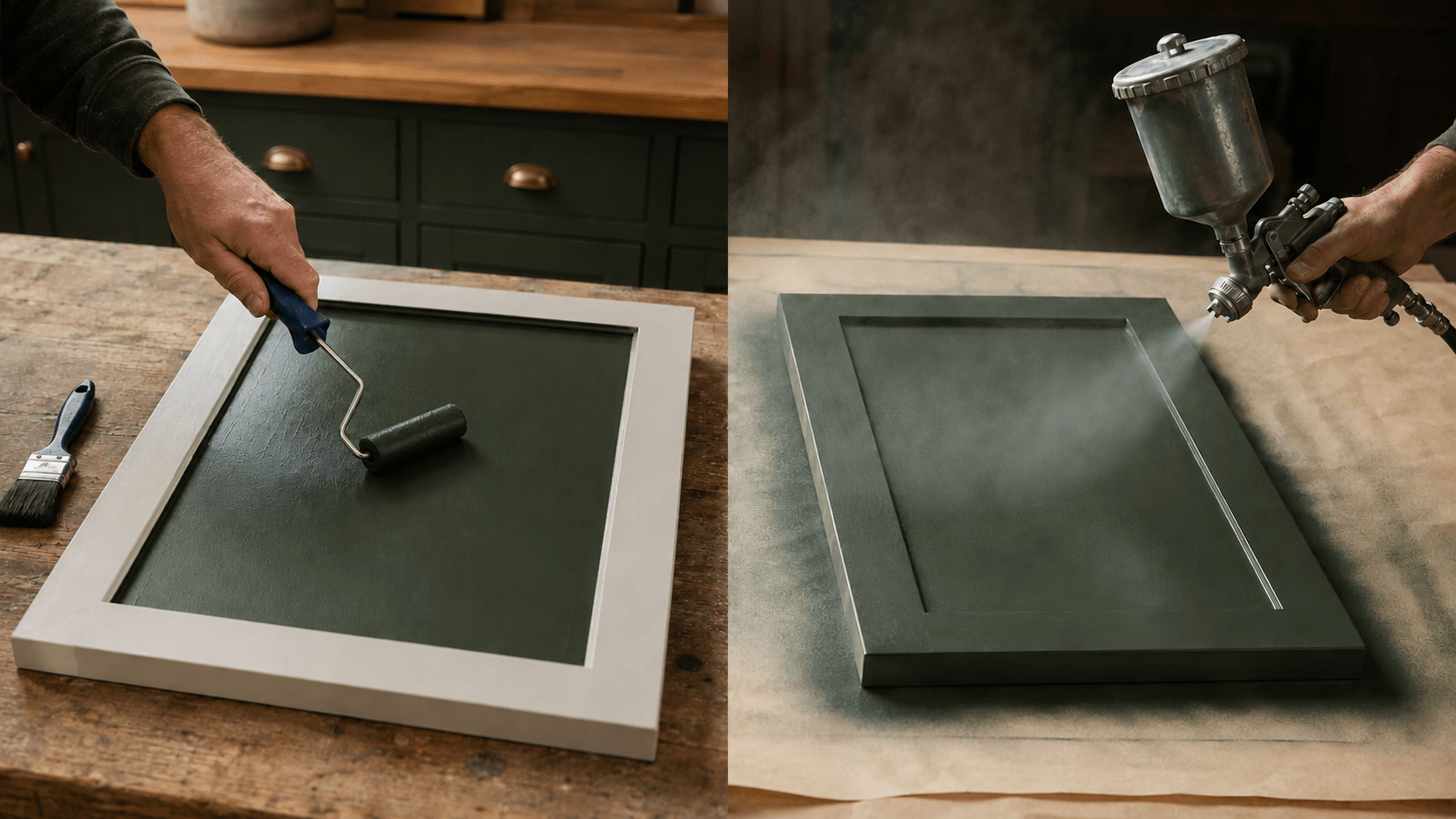
Spraying and hand painting are two very different ways of refinishing a kitchen. Either method can produce a good result in skilled hands, but the application method alone does not determine how well the finish will perform.
David strongly favours a carefully built, hand-applied finish. That opinion comes from approximately 40 years of painting and decorating experience and from being asked to put right kitchens that have previously been sprayed badly. The recurring problems are not limited to appearance. He has encountered poor preparation, weak adhesion, chipped edges, cracking around joints, visible defects, overspray and unnecessary mess inside customers' homes.
David's view: A competent spray specialist using a suitable, properly prepared coating system can produce an excellent kitchen. However, a spray gun, an expensive machine and a short training course do not replace the judgement and practical skill needed to assess and refinish an existing kitchen. A fast two-coat spray job should not be assumed to equal a carefully prepared five-to-eight-layer hand-applied system.
This article explains the practical differences so that homeowners can compare specifications rather than choosing solely on speed, price or claims about how hard the paint becomes.
- Not Every Spray Painter Produces Poor Work
- Why Kitchen Cupboard Painters Are Asked to Correct Sprayed Kitchens
- A Short Course and Expensive Equipment Are Not a Complete Skill Set
- Two Coats Versus Five to Eight: The Number Alone Proves Very Little
- Why a Very Hard Finish Is Not Automatically the Most Durable
- Overspray, Masking and Working in an Occupied Home
- The Appearance Is Different, Not Simply Better or Worse
- Preparation Is More Important Than the Application Tool
- Repairability and Future Maintenance
- Speed and Price Do Not Describe the Same Specification
- Questions to Ask Any Kitchen Painter
- How David Hand-Paints a Kitchen
- David's Professional Verdict
- Would You Like David to Assess Your Kitchen?
- Related Kitchen Cupboard Painting Advice
- Not Every Spray Painter Produces Poor Work
- Why Kitchen Cupboard Painters Are Asked to Correct Sprayed Kitchens
- A Short Course and Expensive Equipment Are Not a Complete Skill Set
- Two Coats Versus Five to Eight: The Number Alone Proves Very Little
- Why a Very Hard Finish Is Not Automatically the Most Durable
- Overspray, Masking and Working in an Occupied Home
- The Appearance Is Different, Not Simply Better or Worse
- Preparation Is More Important Than the Application Tool
- Repairability and Future Maintenance
- Speed and Price Do Not Describe the Same Specification
- Questions to Ask Any Kitchen Painter
- How David Hand-Paints a Kitchen
- David's Professional Verdict
- Would You Like David to Assess Your Kitchen?
- Related Kitchen Cupboard Painting Advice
Not Every Spray Painter Produces Poor Work
It would be unfair to say that every sprayed kitchen is bad. There are experienced tradespeople who understand coatings, extraction, preparation, masking, application conditions and the surfaces they are working on. When the complete system is appropriate and the work is controlled properly, spraying can create a very smooth, uniform finish.
The difficulty is that customers cannot judge competence from photographs of a newly completed kitchen alone. Most finishes look clean when they are fresh. The more useful questions concern what happened beneath the colour coat, whether the products were compatible, how the fixed sections were treated and how the finish behaves after months or years of normal kitchen use.
David's criticism is therefore not of every person who sprays. It is directed at rushed specifications and the mistaken idea that spraying is automatically more professional, more durable or more technically advanced than hand painting.
Why Kitchen Cupboard Painters Are Asked to Correct Sprayed Kitchens
A significant proportion of Kitchen Cupboard Painters' work comes from customers whose cupboards have already been painted, including kitchens that were previously sprayed. Some require a colour change after years of satisfactory service. Others need attention because the earlier finish has failed or was poorly executed from the start.
Problems David has personally encountered include:
- paint chipping from edges, corners and frequently handled areas;
- cracking where timber joints have moved;
- coatings that have not bonded securely to the original surface;
- thin coverage on profiles, edges or less visible sections;
- runs, rough dry spray, orange-peel texture, dust and other visible defects;
- overspray on nearby surfaces, fittings or parts that were not adequately protected;
- fixed frames that do not match the finish achieved on removable doors;
- damage concealed beneath a fresh colour rather than properly assessed and repaired.
None of these defects proves that spraying must fail. They show why preparation, product knowledge, environmental control and application skill matter more than ownership of the equipment.
A Short Course and Expensive Equipment Are Not a Complete Skill Set
Modern spray systems make it possible to apply paint quickly, and training courses can teach useful equipment and safety fundamentals. What a short course cannot provide is the accumulated judgement that develops through years of working with different surfaces, old coatings, contamination, repairs, timber joints and unfamiliar factory finishes.
Kitchen refinishing begins before the paint is opened. The painter must decide what the doors and panels are made from, whether the original coating is stable, whether grease or household products have contaminated the surface, whether moisture has affected MDF, and whether repairs will remain sound beneath a new finish.
A spray gun cannot make those decisions. In inexperienced hands it can simply cover an unresolved problem very quickly.
This is one reason cheap spray quotations can be difficult to compare with a more involved hand-painted specification. The customer may be comparing two different levels of assessment, preparation, coating build, on-site protection and aftercare rather than two methods of applying the same job.
Two Coats Versus Five to Eight: The Number Alone Proves Very Little
David has seen spray painters dismiss his system because a sprayed kitchen may be completed with two colour coats, whereas Kitchen Cupboard Painters normally applies between five and eight coats of suitable water-based products.
That comparison sounds simple but is misleading. David is not applying eight identical topcoats merely to make the job last longer. The complete build can include products selected for adhesion, isolation, sealing, colour change and final protection. The number and type of coats vary according to the original surface, its condition and the chosen colour.
Likewise, two sprayed coats are not automatically inadequate. Their performance depends on the particular product, the specified film build, the preparation, the substrate and whether the coating has been applied and cured within its technical requirements.
The sensible comparison is therefore not two coats against eight. It is one complete coating system against another. The system must be appropriate from the original cupboard surface through to the final finish.
Why a Very Hard Finish Is Not Automatically the Most Durable
Hardness is often presented as proof of quality. A coating needs enough hardness and resistance to cope with cleaning, handling and everyday kitchen use, but hardness is only one property.
Timber is not an inert sheet of metal. It responds to changes in moisture and humidity, and joints can move slightly over time. Even protective coatings slow moisture movement rather than preventing it completely. A coating system must therefore combine adhesion, toughness and an appropriate degree of flexibility for the surface beneath it.
A very hard film may perform well when it is properly bonded to a stable and compatible surface. If it is brittle, poorly adhered, unsuitable for the substrate or bridging a moving joint, however, hardness can become a weakness. Chipping and cracking may then occur instead of the finish moving sufficiently with the underlying material.
This does not mean that every sprayed coating is brittle or every hand-applied coating is flexible. Those are product and system characteristics, not automatic consequences of the tool used. David's point is that the phrase the paint dries very hard is not, by itself, evidence that a kitchen finish will last.
Overspray, Masking and Working in an Occupied Home
Spraying creates airborne paint mist. The amount and distance it travels depend on the equipment, pressure, product, technique, extraction and working environment. The Health and Safety Executive notes that conventional spraying can create considerable overspray or mist that travels significant distances.
A conscientious sprayer controls this with suitable equipment, extraction, containment and extremely careful masking. If the work is being carried out inside an occupied home, that preparation is not optional. Floors, worktops, appliances, walls, openings and adjoining areas must be protected appropriately.
When controls are inadequate, overspray can settle where it was never intended. David has been called to kitchens where the mess surrounding the work was as concerning to the customer as the finish on the cupboards themselves.
Kitchen Cupboard Painters avoids spray application. David removes the cupboard doors and drawer fronts and transports them to his workshop, where they are prepared and hand-finished. The fixed frames, end panels, plinths and other non-removable sections are prepared and painted at the property using small rollers and brushes. Approximately 90% of the work is completed away from the customer's home, reducing disruption without introducing spray mist into the kitchen.
The Appearance Is Different, Not Simply Better or Worse
A well-sprayed kitchen is usually chosen for its very flat, uniform, factory-like appearance. Some homeowners prefer that look. Others want the substance and character of a traditional hand-painted finish, particularly in timber, shaker-style, in-frame or older bespoke kitchens.
David's hand finish is carefully controlled to minimise obvious brush and roller marks. It is not intended to imitate a thin sprayed skin. Small rollers and brushes allow the coating to be worked into profiles, edges and fixed areas while maintaining a consistent appearance across both removable and non-removable sections.
The choice should therefore be explained honestly. A customer seeking an absolutely flat factory-style coating may prefer a high-quality spray specialist. A customer who values a substantial hand-finished appearance, careful on-site control and future maintainability may prefer David's method.
Preparation Is More Important Than the Application Tool
Most premature failures begin below the visible topcoat. Kitchens accumulate airborne grease, cooking residues, cleaning products, polish and contamination that ordinary household washing may not remove sufficiently for painting.
The original surface also matters. Solid timber, sound MDF, suitable plywood, an old painted finish and a factory-applied coating do not necessarily require the same preparation or supporting products. Moisture-swollen boards, peeling coverings and unstable coatings may be unsuitable for repainting unless the problem can first be resolved.
Spraying does not reduce the need for this assessment. In fact, the speed and smoothness of spray application can make a weak specification look convincing for a short time. The quality of the bond may only become apparent later, after knocks, cleaning, humidity changes and daily handling.
David inspects each kitchen before quoting because he is assessing the existing construction and finish, not merely counting doors.
Repairability and Future Maintenance
Kitchens are working rooms. Cupboard edges are knocked, handles loosen, water is splashed and doors receive repeated contact. Even a professionally finished kitchen may eventually acquire isolated wear or accidental damage.
A hand-applied system is often more practical to maintain locally because the same application method can be used for careful remedial work. With a very flat sprayed finish, a small touch-in may be more noticeable and the complete door or panel may need refinishing to achieve a consistent appearance.
This is not a criticism of a good spray finish; it is a practical difference worth discussing before the work begins. Customers should ask how future chips or damage would be repaired and whether matching products and colour information will be retained.
Speed and Price Do Not Describe the Same Specification
A spray system can apply colour efficiently, so the quotation may promise a shorter turnaround. That can be attractive, but speed should not be considered in isolation.
Ask what the quotation includes: inspection, removal and refitting, labelling, degreasing, surface preparation, repairs, primers or isolation products, treatment of edges, fixed sections, masking, drying and curing allowances, and what happens if the original coating proves unstable.
Kitchen Cupboard Painters' projects generally take approximately 10 to 15 working days, depending on the size, construction and condition of the kitchen. That time reflects the complete process rather than the number of minutes needed to put colour onto a door.
Questions to Ask Any Kitchen Painter
Whether you are considering hand painting or spraying, ask the tradesperson to explain the complete system in plain language:
- How will you identify the existing surface and coating?
- How will grease, silicone, polish and other contamination be addressed?
- What happens if the original finish is loose or incompatible?
- Which parts will be removed and where will they be finished?
- How will fixed frames, end panels and plinths be treated?
- If spraying takes place in the home, how will mist, ventilation and overspray be controlled?
- Does the proposed system suit timber movement, MDF edges and existing joints?
- What drying and curing time is allowed before reassembly and normal use?
- How could accidental damage be repaired later?
- Can you show relevant completed work and explain how it has performed over time?
A professional should be able to answer these questions without relying only on phrases such as factory finish, industrial strength or dries rock hard.
How David Hand-Paints a Kitchen
After inspecting the kitchen and confirming that it is suitable, David carefully removes the cupboard doors and drawer fronts and takes them to his workshop. Customers do not need to remove or transport anything themselves.
The removable parts are prepared and finished in controlled stages. David returns to the property to prepare and hand-paint the fixed frames, end panels, plinths and other sections that must remain in place. He uses suitable water-based products applied with small rollers and brushes, normally building a system of between five and eight coats according to the surface and colour change.
The aim is not to complete the kitchen in the fewest possible coats. It is to create a compatible, durable and maintainable finish while keeping most of the work away from the customer's home.
David's Professional Verdict
Spraying is not automatically bad, and hand painting is not automatically good. Both can fail when the kitchen is incorrectly assessed, inadequately prepared or coated with an unsuitable system.
The difference is that David does not accept the claim that a quick sprayed finish is superior merely because it looks flat, uses fewer coats or dries hard. Those features say little about the preparation beneath it, its adhesion, its response to movement, the quality of the fixed sections or how easily it can be maintained.
David chooses hand painting because it suits the substantial finish he wants to provide, gives him close control over every profile and fixed section, and has proved dependable across many different kitchens during his working life.
If a homeowner prefers a sprayed factory-style appearance, David recommends choosing an experienced spray specialist who can explain the entire coating system and demonstrate established work. If the customer wants a carefully prepared, hand-finished kitchen with minimal spray-related disruption in the home, Kitchen Cupboard Painters offers a distinctly different service.
Would You Like David to Assess Your Kitchen?
David normally prefers to visit the property before providing a quotation. This allows him to inspect the doors, drawer fronts, fixed units, existing coating and any damage properly.
Request an assessment Call David: 07454 965509
You can also read the kitchen cupboard repainting price guide.